Views: 0 Author: Zhongjing® Furniture Publish Time: 2025-10-27 Origin: Zhongjing® Furniture


Zhongjing® Furniture (est. 2016) manufactures contract-grade solid wood dining tables, chairs, and booth seating for cafés, bistros, QSRs, hotels, corporate canteens, and school dining. We integrate design → prototyping → smart manufacturing → ISO QC → export packing → global shipping → after-sales, enabling chains to scale from first store to 100-store rollout with consistent specs and OEM/ODM options.
Brand storytelling: Natural grain and warm tone elevate perceived quality and brand value.
Longevity: Refinishable surfaces reduce lifetime cost vs. frequent replacement.
Sustainability: FSC-available options; repairability > landfill.
Guest experience: Comfortable tactile edges and thermal feel improve dwell time and satisfaction.
Standard height: 29–30 in (740–760 mm)
Top thickness (net): 1.0–1.5 in (25–38 mm) typical; 1.75 in (45 mm) for premium statements
Chair seat height pairing: 17–18 in (430–460 mm)
Knee clearance: ≥27 in (685 mm)
Rectangular — 24"×24" (610×610) 2 pax · 24"×30" (610×760) 2 pax · 30"×30" (760×760) 2–4 pax · 30"×48" (760×1220) 4–6 pax · 30"×60" (760×1525) 6 pax · 30"×72" (760×1830) 6–8 pax
Round — Ø30" (Ø760) 2 pax · Ø36" (Ø915) 3–4 pax · Ø42" (Ø1065) 4–5 pax · Ø48" (Ø1220) 5–6 pax · Ø54" (Ø1370) 6 pax · Ø60" (Ø1525) 6–8 pax
Ops tip: Use 24"×30" two-tops that push together into a 48"×30" four-top during peak periods.
| Species | Look & Tone | Best For | Notes |
|---|---|---|---|
| Oak | Visible grain, neutral-warm | Bistros, premium casual | Hardwearing; takes stains well |
| Ash | Bold grain, light tone | Nordic/modern cafés | Excellent for natural or light stains |
| Beech | Fine grain, pale | Contract projects | Stable, cost-efficient, uniform |
| Rubberwood | Light, subtle grain | Value-engineered chains | Sustainable, budget friendly |
| Walnut | Dark, luxurious | Boutique hotels, flagship stores | Premium price; showcase lighting helps |
Construction: Solid staves or finger-jointed lamellas with grain-matched orientation; breadboard ends optional for movement control on long tops.
2K/PU commercial topcoat (matte/satin): Best all-round restaurant choice; stain/abrasion/heat resistant; easy daily care.
Hardwax oil: Warm touch and repairable on site; specify maintenance plan; good for premium casual.
Waterborne PU: Low odor/low VOC; ensure adequate film build for heavy traffic.
Edge Profiles: Eased R2–R4 for comfort; bullnose/waterfall for family dining; micro-bevel to hide minor edge wear.
Core & joinery: Anti-warp lamella layout; splines/dowels at seams; threaded inserts for base mounting.
Underside bracing: Steel channel or battens on long spans; keeps tops flat in AC/heated spaces.
Movement allowance: Slotted holes and figure-8 fasteners to accommodate seasonal expansion.
Base pairing:
2-tops → T-base or Ø17–19" disc
4-tops → larger T-base or Ø22" disc
Long rectangles / Ø54–60" rounds → dual T-bases or heavy disc pair
For stone/wood hybrids or extra-thick tops → weighted, corrosion-resistant bases with leveling glides
Heat & stain: Specify topcoats tested against coffee, wine, oil, sanitizer.
Seam control: Tight joints; underside seal to reduce moisture ingress.
Edges & corners: Eased/radiused edges reduce chipping and guest impact risk.
Docs: Finish data sheets, cleaning guide, material traceability; E0/E1, CARB-phase or equivalent emission options on request.
Main aisle: 36–48 in (915–1220 mm)
Table edge-to-edge: 18–24 in (455–610 mm)
Accessible dining: tabletop 28–34 in (710–865 mm) with 27 in (685 mm) knee clearance and at least one clear route.
Daily: Neutral pH cleaner + microfiber; wipe spills promptly.
Weekly: Check fasteners, leveling glides, and edge condition.
Quarterly: Renew oil/wax if applicable; touch-up clear coats as needed.
Avoid: Abrasives/solvents; soaking cloths at seams; direct outdoor exposure unless specified for exterior use.
Dimensional tolerance (±2 mm typical) & flatness check across diagonals
Film build & sheen match per finish swatch; cross-hatch adhesion test on samples
Insert pull-out tests for base fixings; wobble test with final base
Export packing: corner/edge guards, foam wrap, moisture barrier, crate or heavy-duty carton with skid
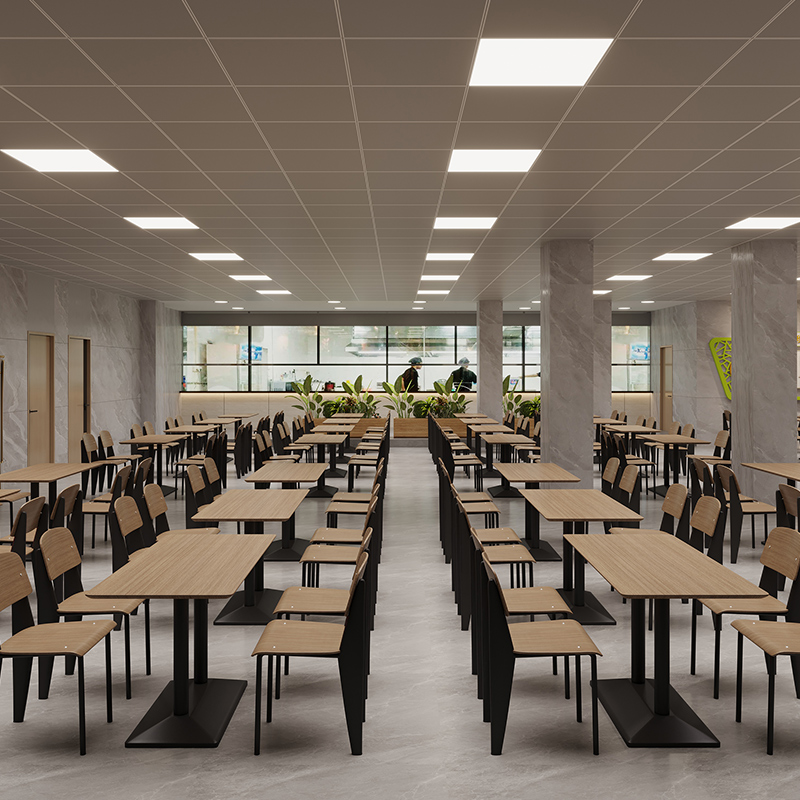
Brief & seat targets — 2-top/4-top mix, concept palette, target dwell time
Material board — species, stain, sheen; base finish (black, brass, gunmetal, etc.)
Prototype & validation — sample top; on-model photos/video; edge profile sign-off
Spec lock & labeling — SKU, barcodes, franchise kits, install drawings
Production & ISO QC — dimension, finish, stability, and packaging checks
Shipping — consolidated containers; incoterms; documents for customs
After-sales — care guide, spare glides/repair kit, warranty terms
Species selection & grade (knots allowance, lamella width)
Top thickness & edge type (eased vs. bullnose)
Finish system (2K/PU vs. hardwax oil) and sheen
Base type/weight and hardware
Order volume and rollout cadence (pilot → batch → chain)
Share your budget per table and expected service life (years); we’ll optimize the spec to meet both.
Send: floor plan, store count, species/finish preference, opening date, incoterms.
Receive: layout suggestion + finish board + unit pricing matched to your brand.
Zhongjing® Furniture — Contract Dining Specialists
Email: felix@nazj.com | Website: www.omzj.com
Q1: Will solid wood tops survive heavy restaurant use?
Yes—when paired with commercial topcoats (2K/PU), proper base support, and a simple care plan.
Q2: What thickness should I choose?
25–32 mm suits most restaurants; >38 mm for premium statements or long spans with added bracing.
Q3: Can we refinish after years of service?
Absolutely. Solid wood allows sanding and re-coating to refresh color and sheen.
Q4: How do we keep tops flat across seasons?
Use engineered lamella construction, underside bracing, and movement-friendly fasteners; control indoor humidity.